main themes: moments - news - diary of

Showing posts with label Steve_Wing. Show all posts

Thursday, February 18, 2010

Núcleo Arqueológico moment


In one of those happy accidents of traveling, we arrived at just the right time at the Banco Comercial Português, located near the Tagus River in downtown Lisbon. There an archeologist took us beneath the bank building for a personal tour of an archaeological dig /museum. “Lisbon,” she said, “has been continuously inhabited since the Bronze Age, so any time you dig the foundation for a new building, you are likely to find something." But this sprawling dig was remarkable in exposing evidence from various stages over a 2500 year long history, including archaeological structures and artifacts "from the Romans to the Moors, from the Visigoths to the Medieval and the Pombaline periods, down to the phreatic layer.”

The site was used as a pottery workshop, and there is a lovely 3rd century mosaic floor. She showed us an oven dating from the Moorish period and the base of the Pombaline 'gaiola' (birdcage) structure invented by the 18th-century engineers to resist earthquakes such as the one that destroyed the city in 1755.

I was particularly fascinated by the large square vats that were used for the production of fish sauce. This was an important flavoring ingredient used for hundreds or thousands of years and was traded all around Europe. It was a big industry in Lisbon. They would bring in the catch and cut the fish up into these vats with water, salt, and herbs. After it was fermented for an appropriate time, it was filtered and put into amphorae with their bases pointed to facilitate stacking them in ships’ holds.

“Fish sauce was everywhere,” she told us, “almost like Coca Cola or McDonald’s today. The aroma and flavor of fish sauce were familiar to virtually everyone, all across Europe.”

But at some point, the fish sauce industry died out. There was evidence of its passing, as one of the vats had a new wall constructed within it to divide it into smaller cells, and a skeleton was interred on one side. Having lost its use for making fish sauce, the vat had been subdivided and used for a burial.

“Now,” the archaeologist continued, “the flavor of fish sauce has been lost. Nobody knows exactly how it was made. This flavor that once was so common in Europe has completely disappeared.” Of course, there are other fish sauces in other places, like Asia, but they may not be the same.

It is a thought that stayed with me long after we left the Núcleo, that a once ubiquitous flavor has been lost. Surely many other flavors, too. What endures and what does not? It is a question that applies not only to archaeology and to the past, but also to the present. Sometimes the answers are surprising.

Saturday, October 24, 2009

Elevador da Gloria: some cars need a wash


(click to enlarge)

Lisboa is a city of hills, but has some transport options to help with the climbing. Elevador de Gloria goes up to the Barrio Alto neighborhood from the district below.

Elevador da Gloria looks like a tram but only runs up this hill and back down. It has a twin that makes the opposite run, out of sight around the curve at the bottom

Lisboa has many charms, but made me, who often appreciates graffiti, wonder how much is too much. And related to this particular graffiti on the Elevador, who knew there was a Beach Boys revival? We were waiting for a bus one day near Lisboa and part of the queue was a group of teenage German girls. They sang Beach Boys songs to pass the time. I was amazed that they knew the lyrics and the harmonies so well!

But then, another day, at a miradouro atop another hill, two guys were jamming classic Brazilian tunes. The drummer was Brazilian, but the guitarist was from Poland. "You should not be surprised," he said. "Brazilian music is everywhere."

Like graffiti, I thought. Only smoother.

Sunday, August 23, 2009

kiva


Reading Stephen Maurer's poem Mimi's Solution, at first I thought instead of 'yurt' he meant a different circle structure, 'kiva,' like the one pictured here. Only this is ruins of a kiva, a ceremonial room, a sacred place for those who built these walls. But of course, his poem itself reveals that he meant 'yurt.' And the link below his poem leads to a kiva experience.

Still, it reminded me of Chaco Canyon, where the photo was taken. It is a national park, whose website includes this under 'directions' - "Warning: Some of the local roads recommended by map publishers and services using GPS devices to access Chaco are unsafe for passenger cars." They might have warned, too, that even the road they recommend is a 35 km journey after you turn off the highway to Cuba, NM, and much of this road seems designed to shake you until you wonder what parts might have come loose and fallen off your car.

This tends to discourage casual tourists, apparently, because we had the place almost entirely to ourselves. And Chaco Canyon is a beautiful place to go, to camp. To walk amid the ruins and feel the presence of their absence, of those people who built and lived there and chiseled their symbols in the rocks. Who grew from children and themselves raised families in this community, in this culture. And added stones to its walls. Someone told us that the word Anasazi is Navajo, and has come to mean 'cliff dwellers,' but originally meant something like 'ancient ones.' Or, said another way, it meant 'we don't know who they were.'

Thursday, June 11, 2009

stormchased


What enticed us to walk so far down the beach? Warm sunlight on our skin, salt-scented breeze. When we got warm, we splashed in the water, where the curling waves pushed up foamy aprons of cool surf. Then we would wander over toward the dunes, where the crabs dug their burrows and lines of clustered shells had been left by the tide. But always moving toward the point. Walking in the company of black-headed gulls and groups of scurrying sanderlings. Walking to the rhythms of the crashing waves.

The point of the island had always seemed too far before, but this morning it felt so easy to just keep walking, kilometer after kilometer up the shore. So we walked far past the last of the families with kids splashing and screaming with delight, past the surf fishermen, past even the fitness walkers, until we had the entire expanse to ourselves, except for one couple far ahead of us. We meandered toward the point until the first flash of lightening and later its boom of thunder made us notice the storm that was creeping and building over the point.

We turned around, and the car park area at the end of the beach where the lifeguards and people were looked hopelessly far away. The people themselves vanishingly small. The distance yawning open, like looking through binoculars the wrong way. We began walking back as the lightening and thunder continued behind us, and soon that other couple came running past. "We have to run," the woman said apologetically. They ran ahead of us and soon grew small in the distance.

I would have run, too, but my partner was not going to run. Not that she was unaware of the hazard. "Could we be any more exposed to a lightening strike?" she asked. "Maybe if we were hugging a steel flagpole," I offered. We did walk briskly though.

The storm moved in our direction, and the clouds grew heavy with darkness as rain poured behind us. It grew, with part of it moving out to sea beside us, so that it was almost encircling us. We walked, the lifeguard chair tiny in the distance, but not quite as tiny. We walked, feeling the cool wind from the storm on our backs. We walked and the bathing area of the beach grew a little closer. Cold raindrops scattered down on our backs. The storm was gaining on us. We walked. Then I could see it, our blanket and our things in the sand ahead. Maybe we would make it.

Finally we arrived at the deserted bathing area and gathered our things as the rain began to fall. We hurried over the dunes to the car park, where just a few people remained. The danger and sensory intensity was exhilarating. But we were relieved to be snug in the cozy car, from where we could appreciate the beauty of the storm in a different way.

Thursday, January 01, 2009

Tracks


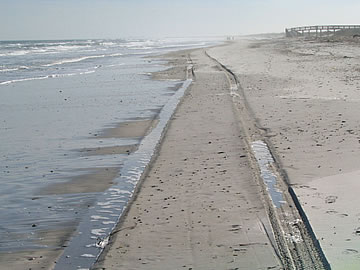
Yesterday on the beach, I walked along the tire tracks the beach ranger left. Those tracks now were gradually erased by the tide. Just like time erases our tracks and traces. Some of them are not important, so it seems, so it doesn't matter. Some are better erased. But there are some that we wish would not be erased by time. All part of the cycle, though, like leaving a year to enter a new one.

But some things linger. Like a conversation may be over as soon as the sounds of the voices dissipate into space, but the ideas expressed may stay with you. And of course, art of the visual kind and words written, those can stay a long time, from year to year, like in this blog, too. Tracks that are not erased, but that instead can remind us of lessons of years past.

Also I thought of people in my life, and remembered those who are no longer alive. It seems as though their tracks in my heart will always stay, as long as there is my heart.

And I wonder what tracks will be made this year.
What poems will be written? What sunsets will astonish?
What blossoms will be so fragrant that they pause us in our hurries?
What lovers will meet for the first time? Who will be born this year?
In other years to come, what tracks will remain of this year just begun?

----
by: Steve Wing, Florida
originally posted in January 2007

Thursday, July 24, 2008

what bodies are for


What are bodies for, then?
he asked. They give a chance to talk and touch. They let us see and taste, feel, move and make. Make shelter, make gardens. Make music.

No matter how it looks, young or old, dressed
in stockings or a saree, healthy or diseased, smooth or wrinkled, beautiful or plain.

Life is a series of heartbeats, and each one is an opportunity, an invitation to connect with one another. You’ll see it plainly when
that other heart has stopped.

That’s true, she answered, but there is more.
A body comes from another one, don’t forget.
A breast is for nurturing, too.
Bodies are not just for sharing,
a body is a portal too, for bringing life.

And life is not merely a sequence of partners or heartbeats, nor just a line of days like beads on a string.
It is a cycle: we arise from life's source, but then we become
its source. A circle of beginning and becoming and begetting.

His string of beads bent into her circle, then,
and her circle formed a bead on a longer string.
Each heartbeat was
an opportunity becoming,
begetting an invitation to
what bodies are for.

----

words & image: Steve Wing, Florida (about & more)

Saturday, June 14, 2008

tearing

feel the morning sun
tearing holes in the night-
chilled shade of the forest

Friday, December 21, 2007

solstice


winter solstice ~
when disporportional darkness
most overshadows daylight

but in this time of
endings and beginnings,
balance is regained
by encompassing the whole

for in the southern hemisphere,
this same day is gibbous
with summer's beginning

Tuesday, December 04, 2007

Morning news program

Wait, don't reach for the remote
to flick on the television news

Listen for the calls of the migrating birds

Watch the traffic of the clouds
as dawn washes the sky with colour

Feel the throbbing of your pulse
syncopate with the heartbeat of your lover

Tides of breath
Taste of mist
Feel of the earth holding you
Scent of night's blooms closing
Light of day opening

Let this be your morning news program

Wednesday, November 07, 2007

cold delight

Man, what a sunrise today. Overhead that infinity of black and the amazing moon, the crescent so bright and the orb so dark, strangely like a yin-yang. And the god who made maxfield parrish was at work in the east, with such subtle colors low on the horizon, a mixture of blazing daylight in India and hot African deserts blending into the green of Asian terraced mountains and the aqua of Mediterranean shallows before plunging into infinite sea deep blue. Ah. A cold delight.

Wednesday, July 11, 2007

the many-layered embrace


On the way to work this morning,
my bike seemed to drift along,
as if it were choosing
the speed and direction,
letting me, like a passenger,
look around and
see the world
in a different way.

There was a crescent moon,
above the quiet streets,
and as I arrived here,
the east glowed ochre
behind the pines.

The inner voice
of the morning.

It brought back the memory
of a recent thought, just a phrase
from a sleepless night:

the many-layered embrace

I think of it as being
enfolded in a lotus, within
layers of petals and sepals.

It is the embrace of life,
of these bodies and our health,
of home and country,
and this beautiful crazy planet.

The embrace
of abundance,
of food and comfort.
of love, our families, our friends.

And we respond,
returning the embrace,
with art, with words, with work,
with concern and care.

With listening to the inner voice
of a place,
of a person,
a moment.
By seeking to attain the source,
connect with the basis.

It is a many layered embrace,
only there is no way
to say it,

And no way
to stop trying
to say it.

Wednesday, November 29, 2006

back to work


This morning, a beautiful ride to work. Dark clouds, but stripes and a horizon of colours shining through. Dim, but the streets shining with a little rain. And the trees, while we were gone they seemed to find their autumn coats. So many reds and oranges and yellows. It is good to ride again, and let my mind be quiet as I roll through a part of this magical intersection, where the surface of earth is washed by starglow, where miracles are normal. Where the branches and twigs of trees slice the wind into ribbons of breeze that curl around me as I ride.